
Get a 24 hour weather forecast
Grass growth remains under significant pressure across much of the region, with the continuing dry conditions now clearly reflected in both milk volumes and milk solids performance. As a result, maintaining cow intake to protect milk production and overall lactation is the most important priority in the days and weeks ahead.
As we are moving into mid-August, we must also start planning for the back end. Traditionally, this is the period when farms focus on building autumn grass covers, extending rotation length and preparing for the winter ahead.
Starting from a lower grass base means many farms will need to adjust their plans. Silage stocks are already being fed on many farms and will continue to be required throughout the back end, placing additional pressure on winter forage supplies.
The following five steps will help you assess your position and develop a plan for the remainder of the grazing season and into winter.
The first step is to assess your current winter fodder position by completing a fodder budget. Strong early silage cuts are already being fed, and more will be required before we move into the traditional winter feeding period.
What can be achieve will be rain dependant, but assuming the rain comes, be ready to spread fertiliser appropriately.
– Fertiliser should not be spread if growth stays below 35 kg DM/ha, as plants do not uptake fertiliser efficiently when growth is restricted and nutrients can be lost to the environment.
– Following rain after a dry spell, soil N mineralisation will occur, releasing soil nitrogen to fuel grass growth recovery.
– Wait 7-10 days after rain before spreading fertiliser, generally when grass growth exceeds 50+kg DM/ha.
– Spreading fertiliser earlier poses a risk to water quality and may result in wasted fertiliser.
– Paddocks actively growing grass (more than 50 kg DM/ha) can receive some fertiliser or dairy washings. Target paddocks reseeded within the last three years, paddocks with optimum soil fertility and paddocks on heavier land.
– Excess chemical N application over the longer term, combined with high levels of soil N mineralisation, can increase risk of nitrate poisoning
– Remember the lessons from 2018.
At present with challenging grass quantities on farm our main priority is to maintain our cows’ daily intakes while trying to keep the rotation to 25 days where possible. Some places have had some rain, but others have had none, but very few have had enough rain. Paddocks that gone brown and going backwards should be grazed. But walk your farm, there could be pockets of ground on your farm that would respond to fertiliser application.
With the localised nature of the rain fall, some farms have a quantity of grass left with growth rates in the high twenties to low thirties. On these farms we need to start planning to build the autumn grass wedge.
What is your current average farm cover vs your target farm cover? How far behind are you?
Typical September growth is c.45kgDM/ha per day. After a dry spell you would expect a bounce in growth, hopefully this backend will deliver stronger than normal growth. To give your farm a chance to build covers use sufficient concentrates and silage to lower grass demand and remove any excess, non-productive and potentially under productive animals from your farm.
Assuming the rain arrives, we need to build grass covers before growth slows in mid to late September. The latest PastureBase data indicates that 53% of farms have a farm cover below 500 kg DM/ha. This is c.200-250kgDM/ha behind where we would like to be.
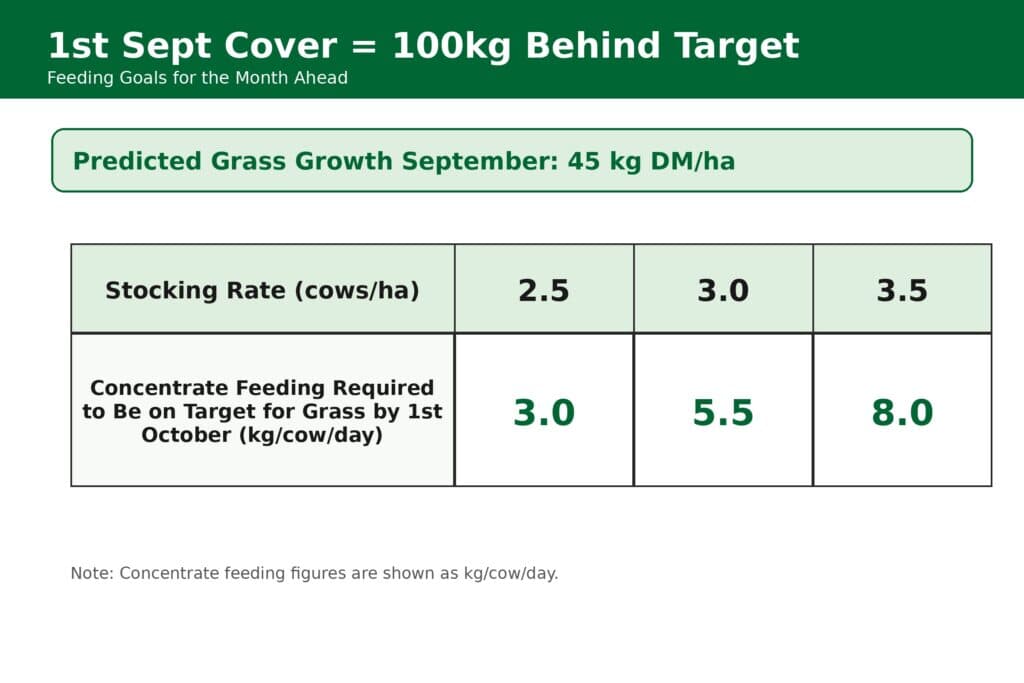
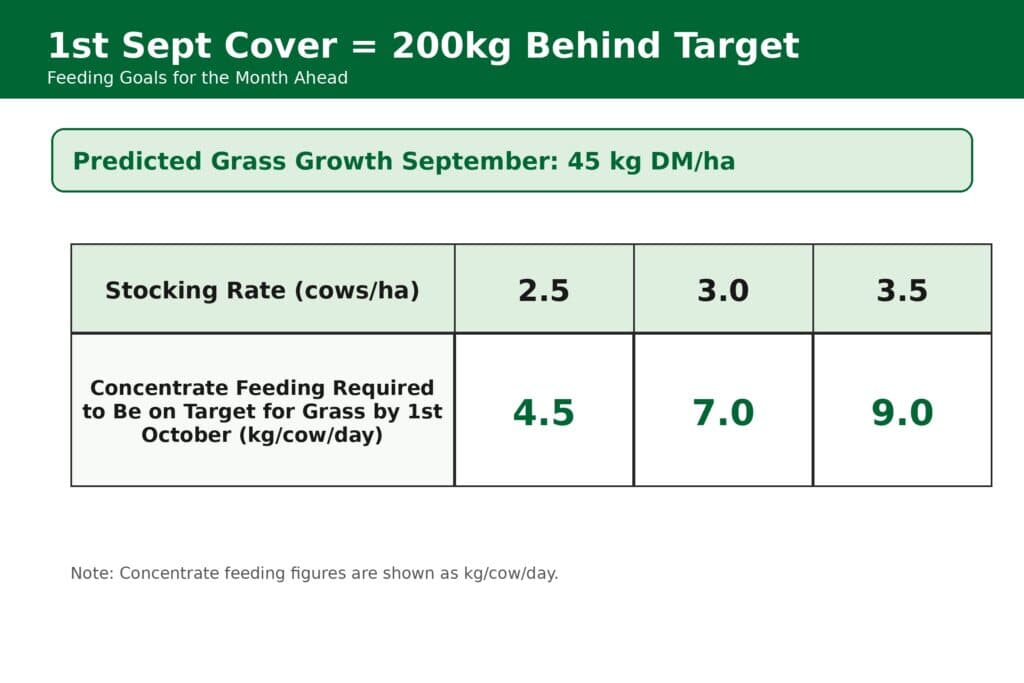
If you are out of grass but have good silage stocks.
For 100 cows you’ll need 5 bales per day + 6 kgs of concentrates in the parlour
If you are out of grass but want to restrict silage.
For 100 cows you’ll need 3 bales per day + 6 kgs of concentrates in the parlour + 4kgs of a forage extender midday.
Keep an eye on milk butterfat%. If it drops excessively, you’ll need to introduce more forage eg straw, more silage, hay.
It is important to remember that each cow in your herd still has the potential to produce in excess of €800-1,000 worth of milk from now until drying off. So far this year, cows have produced approximately 3,800 Litres, with a year-end target of 5,800 Litres.
Maintain cow intake at all times. Your cow will eat grass and concentrates and may also require silage. Concentrates are more effective at maintaining production because they contain more energy on a kilo basis than grass silage. It is energy or UFLs that matter to drive milk production and not where they come from. Four kg DM of concentrates contain c.4 UFL, 4 kgs DM of grass silage depending on quality may contain 2.8 to 3.2 UFLs. However, a kilo of grass silage is better than a kilo of air. Ensure your cows are fully fed every day.
Once the rain comes and growth ramps up you can start planning again. Things are tough now but assuming the weather comes right there is a potential to grow grass in September and early October. And by continuing to feed the likes of the forage extender, dropping your grass demand there may even be an opportunity for a late 3rd cut.
Cows are resilient animals and can utilise nutrition from a wide range of feedstuffs. If the summer has gone against you and you have already made a significant hole in your winter forage stocks, there are alternatives available. Talk to your Area Sales Manager and Milk Advisor now to put a plan in place. Straw, forage replacer feed, native cereals and soya hulls can all play a role in meeting your herd’s winter nutritional needs.
Liam Stack
Ruminant Manager